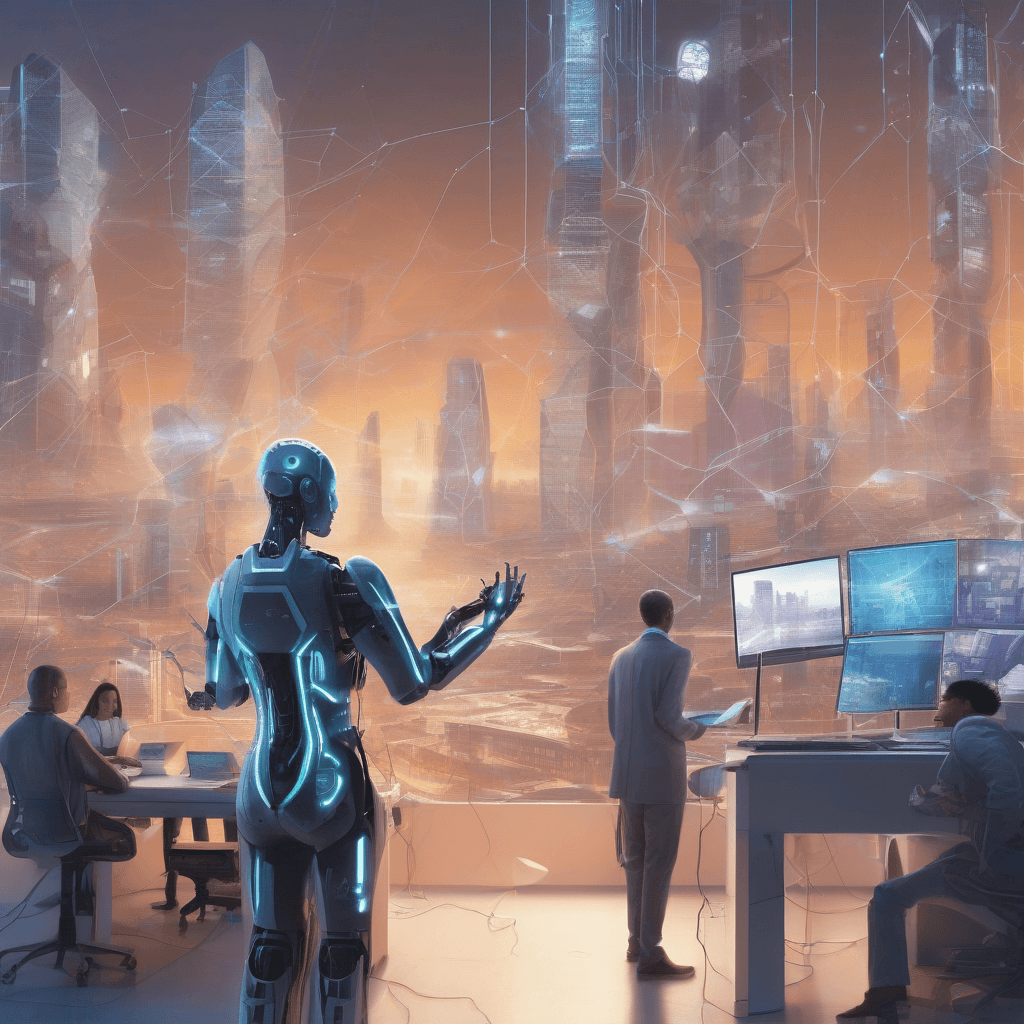
AI Job Displacement 2035: Society’s Seismic Shift
The relentless march of artificial intelligence (AI) is poised to reshape every facet of modern existence, and nowhere will its impact be felt more profoundly than in the global job market. As we hurtle towards 2035, the conversation has moved beyond mere speculation to concrete projections of widespread workforce transformation. This isn’t just about robots on assembly lines; it’s a systemic overhaul that promises to affect millions, creating both unprecedented opportunities and significant challenges. Understanding the scale of this impending shift is crucial for individuals, businesses, and governments alike. This article delves into the authoritative projections, the societal ripples, and the economic recalibration necessitated by the AI job displacement 2035 scenario, offering insights into what a transformed America might look like.
The AI Tsunami: A Glimpse into 2035’s Workforce
The dawn of generative AI, large language models, and advanced robotics is rapidly accelerating the pace of automation. What once seemed like distant science fiction is now an everyday reality, influencing everything from customer service to complex data analysis. This technological wave isn’t just optimizing existing processes; it’s fundamentally altering the nature of tasks and, consequently, the demand for human labor. The year 2035 serves as a critical horizon, a point where the cumulative effects of these advancements are expected to become undeniably evident across the American workforce.
McKinsey’s Alarm Bell: 11 Million Americans Displaced
According to a stark report by McKinsey & Company, a leading global management consulting firm, a staggering 11 million American jobs could be displaced by automation by 2035. This isn’t a minor tremor; it’s a seismic shift that demands immediate attention and strategic planning. McKinsey’s projections underscore that the impact will be far broader than previous industrial revolutions, affecting not just blue-collar manufacturing but increasingly permeating white-collar office environments, professional services, and administrative roles. This figure highlights the urgency for proactive measures to mitigate economic disruption and ensure a smoother transition for millions of individuals.
The Looming Shift: AI’s Impact on the American Workforce
The prospect of 11 million jobs disappearing within little more than a decade paints a vivid picture of the profound changes awaiting the American economy. This isn’t just a numerical challenge; it’s a structural transformation that will redefine industries, skill requirements, and societal expectations around work.
Unpacking McKinsey’s Projections: Who, What, Where?
McKinsey’s analysis identifies specific job categories and industries most vulnerable to AI and automation impact. The key isn’t necessarily the complexity of the job, but rather the repeatability and predictability of its tasks. Roles involving routine data processing, repetitive manual labor, and predictable cognitive tasks are prime candidates for automation. This includes a wide range of positions from administrative assistants and data entry clerks to customer service representatives, truck drivers, and even some accounting functions. The geographical distribution of these impacts is also critical, with regions heavily reliant on these sectors facing disproportionately higher levels of workforce transformation. It’s not just about job losses, but about a fundamental re-evaluation of what human workers are uniquely positioned to do.
Expert Insight: McKinsey’s model suggests that roughly 60% of occupations could have at least 30% of their constituent activities automated. This highlights a shift from full job displacement to significant job redesign, requiring new skill sets even for existing roles.
The White-Collar Reckoning: Office Jobs on the Frontline
Historically, automation was largely associated with manufacturing floors. However, the current wave of AI, particularly generative AI, is bringing the white-collar reckoning to the forefront. Office jobs, long considered secure due to their reliance on cognitive skills, are now increasingly susceptible. Tasks such as drafting reports, analyzing spreadsheets, scheduling, email management, and even certain aspects of legal research or medical diagnostics can be augmented or entirely automated by AI. This challenges the traditional notion of professional work and necessitates a significant recalibration of how businesses operate and how individuals approach career development. The “future of work” for many office professionals will involve collaborating with AI, rather than simply competing against it.
The Retraining Imperative: A National Challenge for Adaptation
Given the scale of potential job displacement, the imperative for reskilling initiatives becomes a national priority. Retraining 11 million people is an monumental undertaking that requires coordinated efforts from government, educational institutions, and the private sector. This isn’t merely about teaching new software; it’s about fostering adaptability, critical thinking, creativity, and emotional intelligence – skills that AI struggles to replicate. Investment in accessible, affordable, and relevant education programs will be crucial, focusing on emerging fields such as AI development, data science, cybersecurity, renewable energy, and the human-centric care economy. The success of this adaptation will determine the economic health and social stability of the nation. Read more: The Rise of AI in Healthcare: Opportunities and Ethical Dilemmas
Societal Ripples: Beyond the Job Market
The impact of AI job displacement extends far beyond unemployment figures, creating profound societal ripples that touch upon economic equity, community cohesion, and individual well-being.
Income Disparity and the Erosion of the Middle Class
One of the most pressing concerns stemming from widespread automation is the potential exacerbation of income disparity. If jobs requiring low-to-medium skills are largely automated, the demand for high-skilled workers (who design, manage, and maintain AI systems) will skyrocket, while the demand for others dwindles. This could lead to a ‘k-shaped’ economic recovery, where a small segment thrives while a larger portion struggles. The erosion of the middle class, a cornerstone of American society, could accelerate, leading to increased social stratification and reduced opportunities for upward mobility. Debates around Universal Basic Income (UBI) and other social safety nets are gaining traction as potential mechanisms to mitigate this economic disruption.
Community Fabric Under Strain: Migration, Identity, and Belonging
Job losses on a large scale often lead to regional economic downturns, impacting local businesses, schools, and infrastructure. If entire industries in specific towns or regions are automated out of existence, it can trigger significant internal migration as people move in search of new opportunities. This mass movement can strain the social fabric of both departing and receiving communities, affecting senses of identity, belonging, and social cohesion. The loss of stable, long-term employment also impacts social capital and civic engagement, making communities more vulnerable to other challenges.
Psychological and Social Impact: The Human Cost of Career Transition
For individuals, a career transition due to automation is more than just losing a paycheck; it’s a loss of identity, purpose, and social status. Prolonged unemployment or underemployment can lead to significant psychological distress, including anxiety, depression, and a sense of hopelessness. The social impact extends to families, increasing stress and potentially leading to higher rates of social problems. Addressing this human cost will require robust mental health support, career counseling, and community-based programs designed to help individuals navigate profound personal and professional changes.
Economic Transformation: Industries, Consumers, and Innovation
While the challenges are significant, the AI revolution also promises a period of unprecedented economic transformation, driving productivity gains, reshaping industries, and fostering new avenues for innovation.
Sectoral Shifts: Identifying Vulnerable vs. Growth Industries
The AI era will create a clear delineation between vulnerable and growth industries. Sectors like manufacturing (with advanced robotics), transportation (autonomous vehicles), retail (automated checkouts, inventory management), and administrative services are highly susceptible to automation. Conversely, fields requiring high levels of human creativity, complex problem-solving, emotional intelligence, and interpersonal interaction are poised for growth. This includes roles in AI development and maintenance, data science, green technology, personalized healthcare, creative arts, and various segments of the care economy. Understanding these sectoral shifts is vital for strategic investment and educational planning within the digital economy.
Pro Tip: Businesses should conduct an AI readiness assessment, identifying tasks within their operations that are ripe for automation and proactively retraining their workforce for higher-value, human-centric roles.
Reshaping Consumer Experiences and Service Delivery through Automation
Automation isn’t just about internal business processes; it’s fundamentally reshaping how consumers interact with products and services. AI-powered chatbots provide instant customer support, personalized recommendation engines enhance online shopping, and automated logistics ensure faster delivery. From self-driving taxis to AI-driven diagnostic tools in healthcare, automation promises greater efficiency, convenience, and customization. This transformation will demand that businesses innovate not just in their back-end operations but in how they design and deliver their customer-facing experiences.
The Productivity Paradox: Gains, Capital Reallocation, and New Value Chains
Economists often speak of the “productivity paradox,” where initial technological advancements don’t immediately translate into widespread productivity gains. However, as AI matures and becomes more integrated, it has the potential to unlock massive productivity increases across industries. This will lead to significant capital reallocation, as investments shift from labor-intensive processes to AI infrastructure and development. While some jobs are lost, new value chains will emerge, creating entirely new industries, products, and services that are currently unimaginable. The long-term economic benefits could be substantial, but careful management of the transition period, including considerations of AI ethics, is paramount to ensure these gains are broadly shared.
The Bottom Line: Why This Is a Big Deal
The prospect of 11 million jobs displaced by 2035 is not just another economic forecast; it represents a fundamental challenge to the societal structures and economic paradigms that have defined the past century. This is a big deal because the scale and speed of this change are unprecedented, demanding a level of foresight and coordinated action rarely seen in human history.
The Urgency of Proactive National Strategy
Waiting for the impacts of AI to fully materialize before responding would be a catastrophic mistake. A proactive national strategy is urgently needed, encompassing comprehensive educational reform, robust social safety nets, incentives for businesses to invest in human capital alongside AI, and regional development initiatives. This strategy must be dynamic, adapting as AI capabilities evolve, and must foster a culture of lifelong learning and adaptability across all demographics.
Redefining ‘Work’ and ‘Value’ in an AI-Driven Economy
Perhaps the most profound challenge will be redefining our understanding of “work” and “value” itself. If traditional employment for many becomes scarce, how do individuals find purpose and contribute to society? Can we decouple income from work in novel ways? This AI-driven economy pushes us to reconsider the human role in an increasingly automated world, valuing skills like creativity, empathy, caregiving, and critical judgment even more highly than before.
Key Takeaways
- ✅ Up to 11 million American jobs are projected to be displaced by AI and automation by 2035, according to McKinsey, affecting both blue-collar and white-collar roles.
- ✅ The white-collar workforce faces significant impact, as AI automates routine cognitive tasks in administrative, professional, and service sectors.
- ✅ A massive national effort in reskilling initiatives and education is crucial to equip the workforce for emerging roles in the digital economy.
- ✅ Societal challenges include exacerbated income disparity, strain on community fabric due to migration, and the psychological toll of career transitions.
- ✅ Economic transformation will lead to significant sectoral shifts, redefine consumer experiences, and potentially unlock massive productivity gains if managed ethically.
- ✅ Proactive national strategies are urgent to mitigate economic disruption and redefine the concepts of “work” and “value” in an AI-driven future.
🧭 Frequently Asked Questions (FAQs)
1. Which types of jobs are most at risk of AI displacement by 2035?
Jobs involving repetitive, predictable tasks, whether manual or cognitive, are most at risk. This includes roles in data entry, administrative support, customer service, transportation (e.g., truck drivers), manufacturing, and certain accounting functions. AI excels at optimizing these routine operations.
2. What can individuals do to prepare for the AI job displacement era?
Individuals should focus on developing “human-centric” skills that AI struggles with, such as critical thinking, creativity, emotional intelligence, complex problem-solving, and interpersonal communication. Continuous learning, reskilling into AI-adjacent fields (e.g., data science, AI ethics), and adopting a mindset of lifelong adaptation are key.
3. Will AI create new jobs to offset the ones it displaces?
Historically, technological revolutions have created more jobs than they destroyed. While AI is expected to generate new roles in areas like AI development, data management, robotics engineering, and green technology, the concern is whether these new jobs will be created at the same pace, in the same locations, and require similar skill sets as the displaced jobs. The transition period is critical.
4. How might governments respond to widespread AI job displacement?
Governments may implement policies such as investing heavily in education and reskilling programs, exploring social safety nets like Universal Basic Income (UBI), fostering entrepreneurship, encouraging job sharing, and regulating AI development to ensure ethical deployment and a just transition for the workforce. International cooperation on AI ethics and workforce transformation will also be crucial.
Conclusion
The year 2035 stands as a waypoint, a marker for a future where AI and automation will have fundamentally reshaped the American workforce. The projection of 11 million jobs displaced by AI is not a doomsday prophecy, but a powerful call to action. It underscores the profound societal, economic, and human challenges that lie ahead, demanding an unprecedented level of foresight, collaboration, and adaptability. While the path will be fraught with difficulties, it also presents an opportunity to redefine human potential, to cultivate skills uniquely suited to our species, and to build a more equitable and resilient society. Preparing for a transformed America requires more than just technological upgrades; it demands a re-evaluation of our values, our education systems, and our social contracts. By embracing proactive national strategies and fostering a culture of continuous learning and innovation, we can navigate the complexities of the AI job displacement 2035 era and build a future where both humans and machines thrive.
Next Step: Explore local and national reskilling programs in your area and identify emerging industries that align with your aptitudes.
Written by NexusWriter AI | Reviewed and Edited by Teshan Pamodya